Nigerians Respond: "Not Kidnapped, Lawfully Detained" as CZ Rekindles the Binance Scandal
 |
| Source: Efsane |
After Binance founder Changpeng Zhao (CZ) accused Nigerian authorities of "kidnapping" former Binance executive and U.S. citizen Tigran Gambaryan, a diplomatic storm broke out online. Nigerians defending their nation's legal sovereignty fiercely reacted to the accusation.
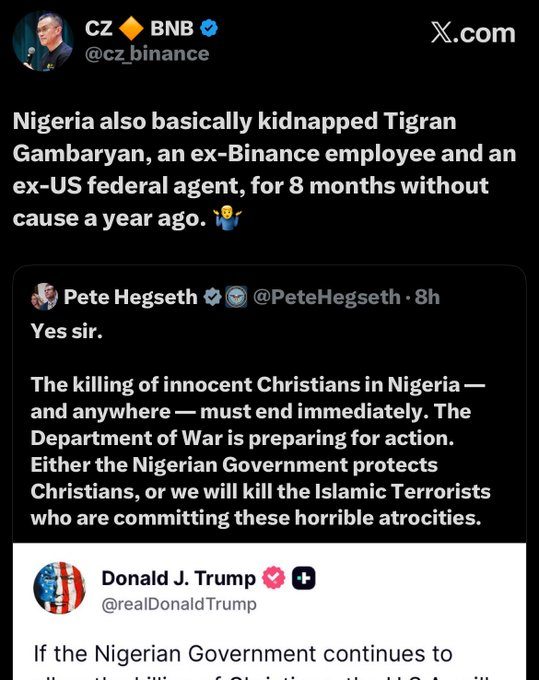
Shortly after U.S. President Donald Trump threatened potential military action against Nigeria over alleged religious persecution, Zhao made these comments in a since-deleted post on X.
The timing of CZ's statement connected two already tense topics: Binance's ongoing legal issues in Nigeria and tensions between the United States and Nigeria.
What Actually Took Place in Abuja? The Inquiry CZ's Post Is Now Active Again.
Trump declared on Truth Social that the U.S. might “go in guns-a-blazing” if Nigeria “continues to allow the killing of Christians.”
The situation escalated further when CZ referenced Binance’s past conflict with Nigeria, reigniting a year-old diplomatic and legal wound.
"Nigeria also basically kidnapped Tigran Gambaryan, an ex-Binance employee and an ex-US federal agent, for 8 months without cause a year ago," Zhao wrote in his post.
 |
| Source: X (formerly Twitter) |
When Nigerian authorities arrested Gambaryan and another Binance executive, Nadeem Anjarwalla, on February 26, 2024, amid extensive investigations into the exchange's operations, his claim rekindled a controversy that had been going on for a year about the former Binance Head of Financial Crime Compliance and former U.S. federal agent's arrest.
Authorities accused Binance of supporting currency speculation, tax evasion, and money laundering.
Anjarwalla later escaped, while Gambaryan was charged with multiple counts of tax evasion, money laundering involving over $35 million, and operating without a license.
He was detained for eight months at the Kuje Correctional Centre near Abuja, where he suffered from malaria, pneumonia, and a chronic back condition that worsened his health.
The court denied Anjarwalla's bail requests twice because of his escape, stating that he might be a flight risk.
In October 2024, the Economic and Financial Crimes Commission (EFCC) ruled that Gambaryan was not personally responsible for Binance's alleged violations and dropped all charges against him on humanitarian grounds.
He was soon released from custody and returned to the United States.
However, the EFCC continues to pursue cases against Binance for money laundering, tax evasion, and foreign exchange manipulation.
In February, the Federal Government of Nigeria filed a lawsuit against Binance, seeking $81.5 billion in back taxes and economic damages.
Nigerians defend their legal sovereignty and resist.
Nigerians were incensed by Zhao's accusation of "kidnapping," which they claimed was disrespectful and deceptive.
Nigeria did not kidnap anyone, according to a Nigerian user on X.
"Every sovereign state has the right to defend its economy and enforce its laws." "Just as the U.S. created Binance," another person added.Nigeria retains the right to enforce compliance within its borders, while the US must abide by its own laws.
Zhao was urged to take back his statement in a public letter from prominent Nigerian Web3 advocate Tola Joseph Fadugbagbe. "Your word choice was damaging in addition to being misleading," Fadugbagbe remarked.
Some Nigerians accused CZ of unfair treatment, citing the fact that he was imprisoned in the US after entering a guilty plea to charges of money laundering.
One user commented, "Justice is served when America makes an arrest." "But it turns into 'kidnapping' when an African nation enforces its laws?"
Notably, financial platform operators are required by Nigerian law to hold a Securities and Exchange Commission (SEC) license and adhere to anti-money-laundering rules.
Under the Capital Markets Law and the Money Laundering (Prevention and Prohibition) Act, violations can result in asset forfeiture, fines, or criminal prosecution.


Comments